


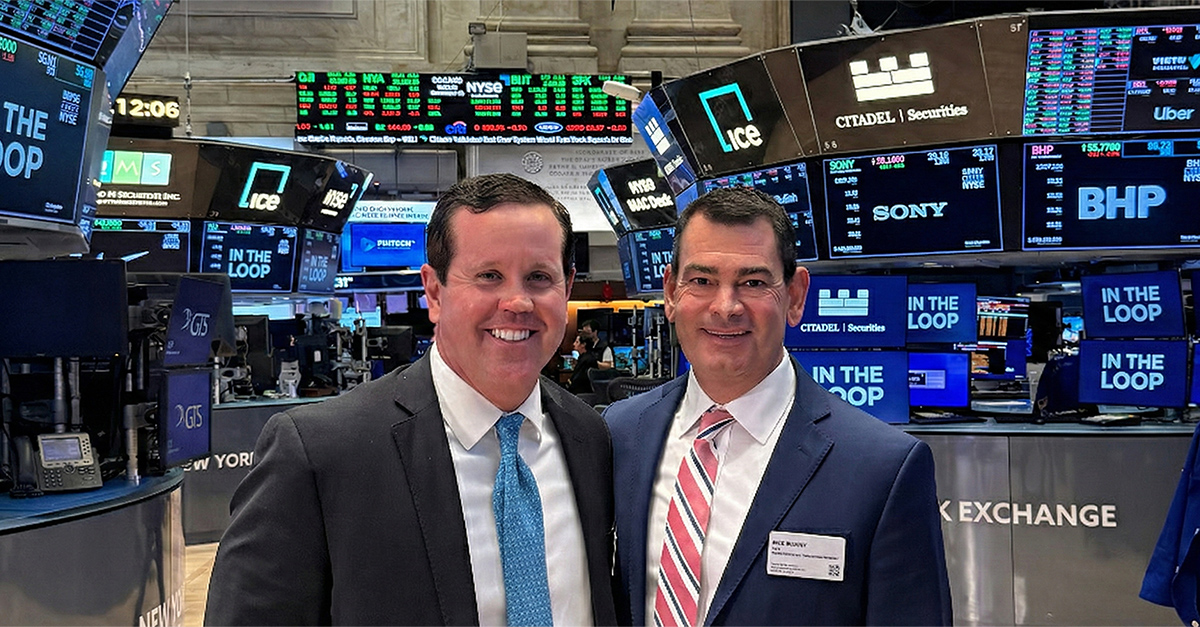
In the Loop – November 20, 2026
“In The Loop” is designed to give you a short update reflecting major developments, earnings, and investment trends across some core Equity Income and Growth holdings. All clients should be aware that individual buy/sell recommendations will be conveyed directly to you on an individual basis. Have a great weekend.
When the facts change, reassess the thesis. When only the price changes, reassess the opportunity. That does not automatically mean selling. Sometimes new facts justify increasing a position, sometimes reducing it, and sometimes doing nothing.
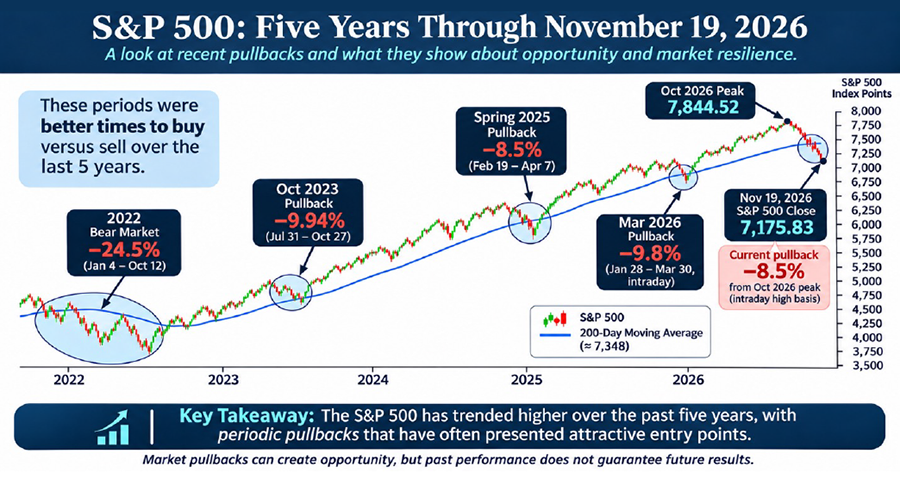
The Chart above is the SP500 over the last five years. The line is the 200 Moving Day Average. As you can see, buying during this moment of uncertainty when stocks traded below the moving average paid off. Obviously, this is not a guarantee. However, based on recent strong earnings, I’d continue to follow this trend today.
History offers an encouraging perspective for investors heading into 2027. Following each of the last nine midterm elections, dating back to 1990, the S&P 500 was higher six months later, nine months later, and one year later. That’s a perfect 9-for-9 record, despite recessions, geopolitical conflicts, rising interest rates, and periods of significant market volatility. While history never guarantees future results, the consistency of this pattern is difficult to ignore. Midterm elections often remove political uncertainty, allowing investors to refocus on corporate earnings, economic growth, and the outlook for interest rates. With recent volatility testing investor confidence, history suggests that patience and discipline may once again prove more rewarding than reacting to short-term market swings.
September 1974 was near the bottom of one of the worst bear markets in modern history. Starting there provides an especially powerful illustration of long-term wealth creation.
I’ll use September 30 for each 10-year anniversary, followed by November 19, 2026, as the current observation. The figures exclude reinvested dividends.
S&P 500 Price Index • September 30 observations
| YEAR | S&P 500 | Period gain | Cumulative gain |
|---|---|---|---|
| 1974 | 63.54 | — | Starting point |
| 1984 | 166.10 | +161% | +161% |
| 1994 | 462.71 | +179% | +628% |
| 2004 | 1,114.58 | +141% | +1,654% |
| 2014 | 1,972.29 | +77% | +3,004% |
| 2024 | 5,621.26 | +185% | +8,747% |
| 2026* | 7,195.00 | +28%* | +11,224% |
Growth since September 1974 113.2×
Annualized price return 9.5%
*2026 uses the November 19 observation, not September 30. The final period is approximately 2.1 years rather than a decade. Source: historical S&P 500 closing levels from SEC filings and market data.
Putting it into perspective: A $10,000 investment tracking the S&P 500 in September 1974 would have grown to approximately $1.13 million by November 2026, even without reinvesting dividends.
Over those 52 years, investors experienced double-digit inflation, soaring interest rates, multiple recessions, the 1987 crash, the technology bubble, the financial crisis and a global pandemic. Bill and I professionally managed client assets during the last three.
Long-term perspectives are calming, but let’s zoom in to the current situation.
I’ve thought about where this period fits relative to the past. It either resembles 1998-1999 which included “The Internet”, technology revolution, infrastructure spending, concentrated leadership and elevated expectations or 1994-1995. During that period the Federal Reserve was raising interest rates aggressively to slow the economy. Alan Greenspan called this period Irrational Exuberance.
That suggests two possible paths for 2027:
1995-style outcome: Inflation moderates, rates stabilize, corporate earnings continue growing, and the bull market broadens.
2000-style outcome: AI investment expectations prove too optimistic, financing becomes more expensive, and investors sharply reduce the valuations assigned to growth companies.
I’m leaning towards 1995. The encouraging difference is that many of today’s market leaders are highly profitable businesses with substantial cash flow, unlike many of the speculative companies of the dot-com era. We believe the opportunity remains significant, but the next phase of this market will likely reward financial discipline and sustainable earnings growth rather than excitement alone. We will adjust portfolio recommendations accordingly. The coming days could be messy as we search for a bottom. However, once the dust settles, we believe we will return to All Time Highs in 2027.
Warren Buffet: “The stock market is a device for transferring money from the impatient to the patient.”
Bullish Points: It appears to me that Oil and Gas Prices as well as Interest rates may have peaked. Anthropic IPO was successful, Semi’s and Tech have priced in a lot of bad news.
Amazon’s investment story continues to improve as its cloud business accelerates and artificial intelligence creates new sources of shareholder value. Third-quarter revenue increased 12% to $201.9 billion, while operating income reached a record $28.1 billion. Amazon Web Services was particularly impressive, with revenue increasing 39% to $46 billion, its strongest growth in nearly five years. However, one of Amazon’s most remarkable investments has been Anthropic, the developer of Claude. Amazon invested approximately $18 billion in Anthropic, and following Anthropic’s November 19 public-market debut, its approximately 1.92 billion shares were worth an estimated $186.6 billion at the $97.17 closing price. That represents roughly $168.6 billion in potential pretax investment appreciation, or more than ten times its original investment. This is predominantly a paper gain, not realized cash profit, and the value will fluctuate with Anthropic’s share price. Amazon also benefits commercially through Anthropic’s commitment to spend more than $100 billion on AWS services over the coming decade. We view Amazon as a company benefiting from AI in two ways: directly through its investment holdings and, more importantly, through the expanding demand for cloud infrastructure, custom Trainium chips and AI services. The major offset is enormous capital spending, with approximately $220 billion planned for 2026, putting near-term pressure on free cash flow.
Formidable Asset Management (“Massey Romans Capital”) is an investment adviser registered under the Investment Advisers Act of 1940. The information presented in the material is general in nature and is not designed to address your investment objectives, financial situation or particular needs. Prior to making any investment decision, you should assess, or seek advice from a professional regarding whether any particular transaction is relevant or appropriate to your individual circumstances. Although taken from reliable sources, the Firm cannot guarantee the accuracy of the information received from third parties.
The opinions expressed herein are those of the Firm and may not actually come to pass.
Author
Paul MasseyRelated posts
In the Loop – May 1, 2026
This week was a busy week for earnings announcements as well as a planned visit
In the Loop – September 18, 2026
Investors are confronting what may be the tallest “Wall of Worry” in years.
In the Loop – June 5, 2026
Markets pulled back sharply on Friday as stronger-than-expected economic data pu