



In the Loop – July 3, 2026
“In The Loop” is designed to give you a short update reflecting major developments, earnings, and investment trends across some core Equity Income and Growth holdings. All clients should be aware that individual buy/sell recommendations will be conveyed directly to you on an individual basis. Have a great weekend.
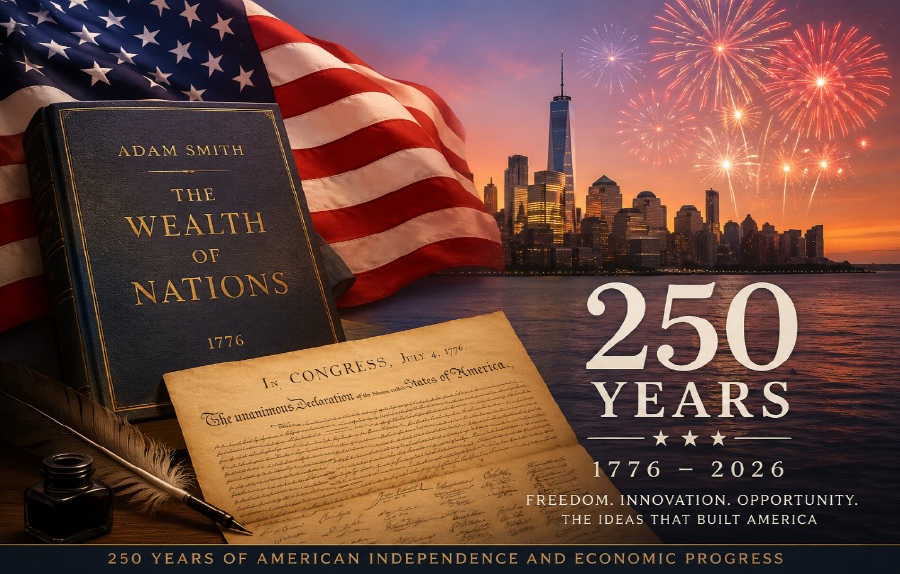
Tomorrow, America celebrates its 250th birthday. As I was thinking about what to write this week, I kept coming back to another milestone that happened in 1776 but doesn’t receive nearly as much attention. That same year, Adam Smith published The Wealth of Nations, a book widely regarded as one of the foundational texts of modern economics.
I’ve always believed that history can be one of the best investment teachers. While markets spend most days reacting to earnings reports, economic data, and headlines, the biggest drivers of long-term wealth are often the ideas that endure for generations. That’s why I wanted to focus this week’s letter on two documents born 250 years ago that, together, helped shape the country and economic system we benefit from today.
The Declaration of Independence gave America political freedom. The Wealth of Nations helped explain why economic freedom matters. Smith’s central idea was surprisingly simple: when people are free to build businesses, innovate, compete, and invest, society becomes more prosperous. He believed wealth wasn’t created by governments directing every decision, but by millions of individuals pursuing opportunity, solving problems, and creating value for others. Looking back over the last 250 years, it’s hard not to appreciate just how powerful that idea has proven to be.
America’s story is really the story of innovation and productive capital. We’ve gone from a collection of colonies to the world’s largest economy by continually investing in the next generation of growth. Railroads connected the country. Electricity transformed manufacturing. Automobiles changed transportation. Semiconductors powered the digital age. The internet reshaped commerce. Today, artificial intelligence, advanced manufacturing, energy infrastructure, and biotechnology are writing the next chapter.
Of course, the journey hasn’t been smooth. America has endured wars, recessions, inflation, financial crises, and periods of tremendous uncertainty. Yet through every challenge, the country’s ability to innovate, adapt, and invest has repeatedly proven stronger than the obstacles in front of it. That resilience is one of the reasons I remain optimistic about the long-term future of our economy.
It also explains how we approach investing. We spend far less time trying to predict tomorrow’s headlines and much more time identifying the companies building America’s future. Whether it’s expanding AI infrastructure, strengthening the electric grid, improving healthcare, enhancing national security, or reshoring critical manufacturing, these are investments that increase our country’s productive capacity. In many ways, they represent the modern version of the capital formation Adam Smith wrote about 250 years ago.
One of the themes we’ve discussed throughout the past year is U.S. Resiliency. To me, that theme isn’t just about geopolitics or government policy. It’s about America’s unique ability to reinvent itself. Our deep capital markets, entrepreneurial culture, world-class research institutions, strong property rights, and willingness to embrace innovation continue to provide advantages that few nations can match. Those strengths have existed for generations, and I believe they’ll continue to drive wealth creation for years to come.
As investors, it’s easy to become consumed by the next earnings season, the next Federal Reserve meeting, or the next geopolitical headline. Those events certainly matter, but anniversaries like this remind us to zoom out. The greatest returns have often gone to those who maintained confidence in America’s ability to innovate through periods of uncertainty rather than react to every short-term challenge.
Two hundred and fifty years ago, a new nation declared its independence while a Scottish economist explained how free people create lasting prosperity. Those ideas have stood the test of time. As we celebrate America’s 250th birthday, I’m reminded that our greatest strength has never been any single company, industry, or technology. It has been the enduring combination of freedom, entrepreneurship, innovation, and investment that continues to move our country forward.
Thank you, as always, for the trust you place in our team. We wish you and your family a safe, relaxing, and happy Fourth of July as we celebrate 250 years of American independence and look ahead with optimism to what the next 250 years may bring.
JPMorgan authorized a new $50 billion share repurchase program while increasing its quarterly dividend by 10%. Citigroup raised its dividend by 12% and continues to execute its existing $30 billion buyback authorization. Goldman Sachs approved a 33% increase in its quarterly dividend and maintained flexibility to continue returning capital through share repurchases. Bank of New York Mellon announced a 19% dividend increase and will continue repurchasing shares under its existing authorization. PNC Financial also raised its quarterly dividend by 18% and expects to accelerate share repurchases during the second half of 2026.
Taken together, these announcements highlight a banking sector that remains exceptionally well-capitalized, highly liquid, and supported by strong regulatory capital levels.
Formidable Asset Management (“Massey Romans Capital”) is an investment adviser registered under the Investment Advisers Act of 1940. The information presented in the material is general in nature and is not designed to address your investment objectives, financial situation or particular needs. Prior to making any investment decision, you should assess, or seek advice from a professional regarding whether any particular transaction is relevant or appropriate to your individual circumstances. Although taken from reliable sources, the Firm cannot guarantee the accuracy of the information received from third parties.
The opinions expressed herein are those of the Firm and may not actually come to pass.
Author
Paul MasseyRelated posts
In the Loop – July 24, 2026
98 S&P 500 companies have reported 2Q results. Reported Sales growth has been +1
In the Loop – August 7, 2026
Today’s employment report delivered a meaningful downside surprise, with the U
In the Loop – April 18, 2025
Markets are facing growing uncertainty as trade tensions, tariff concerns, and c