



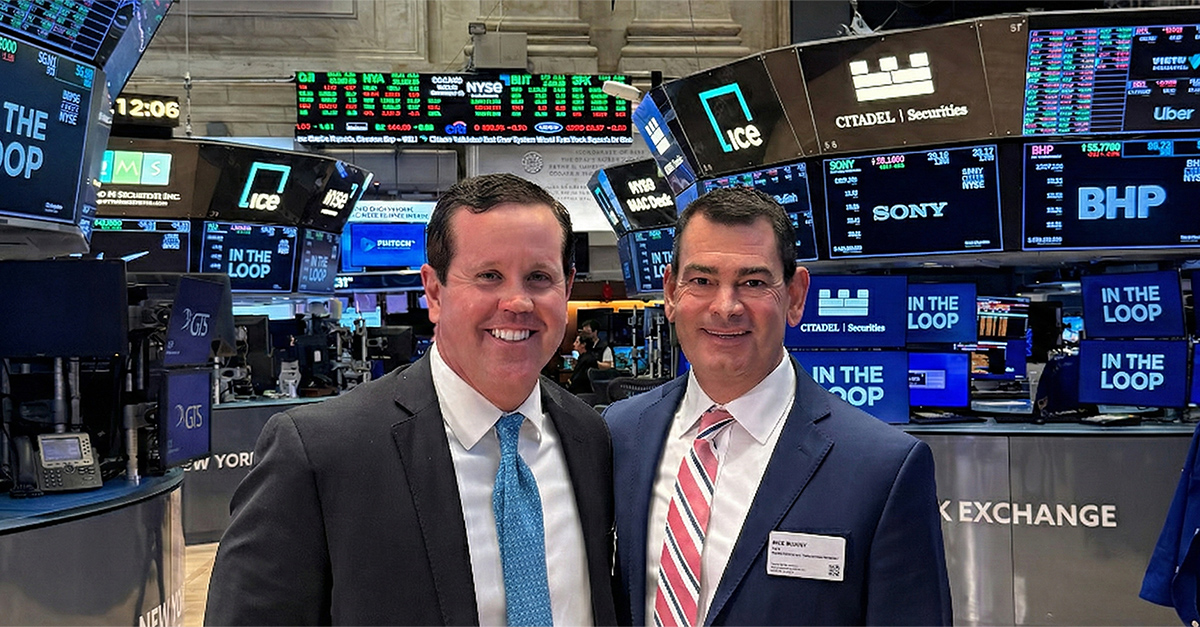
In the Loop – June 26, 2026
“In The Loop” is designed to give you a short update reflecting major developments, earnings, and investment trends across some core Equity Income and Growth holdings. All clients should be aware that individual buy/sell recommendations will be conveyed directly to you on an individual basis. Have a great weekend.
Last Friday was a National Holiday, Juneteenth, and it was also my wife’s birthday, so I skipped our weekly update due to the shortened week. However, this week we have three big themes that we want to cover. The recent swings in artificial intelligence-related stocks, the outlook for Federal Reserve policy, and whether upcoming technology earnings will validate the industry’s heavy investment in AI infrastructure.
This week, the hyperscalers were mixed overall: Microsoft, Alphabet, and Nvidia came under pressure as investors questioned the payoff from AI spending, while Amazon held up better after signs that cloud demand is still accelerating. Think of the hyperscalers’ AI spending like a company building a giant new pipeline system before all the customers have signed up. In the near term, that means a lot of cash is going out the door and profits can look weaker, even if the business is still growing. That kind of spending can work very well if demand keeps rising and the infrastructure gets used, but if too much gets built too fast, returns can disappoint. A good historical parallel is the oil and gas pipeline/buildout cycle, especially the 2010–2015 period, when firms spent heavily on new pipes, processing, and midstream infrastructure to catch up with shale growth. The pattern is like today’s hyperscalers: very large upfront capex, heavy reliance on debt and equity markets, and a bet that demand would keep rising fast enough to justify the build. In the short run, that often worked for the builders and equipment providers. We are calling these companies Picks and Shovels, Bottlenecks or AI Supply Chain. Eventually, returns were mixed because once the system had enough capacity, margins and valuations tended to normalize or compress. This creates winners and losers.
In the short term, midstream companies often saw strong revenue growth because volumes were rising and new assets were getting placed into service. Financing was plentiful, so companies could keep building even if free cash flow was weak or negative. But when the cycle matured, overcapacity and lower commodity prices made the economics less attractive, and several companies had to cut growth spending, restructure, or reset dividend expectations.
Hyperscalers are different businesses, but the capital-allocation logic rhymes: spend heavily now, hope utilization catches up later and accept that near-term free cash flow may be lower. If the buildout is well matched to durable demand, the payoff can be exceptionally large because the winner owns the infrastructure layer for a long time. If demand growth slows or competition forces excess capacity, returns can disappoint even if revenue keeps growing. In other words, the stock can struggle even when the underlying technology is important, just like past boom cycles in energy and telecom.
While it may be premature to conclude that AI infrastructure spending has reached an overbuilding phase, the industry is at a point where investors should monitor key indicators carefully. A signal would be a shift in commentary from supply-chain companies, moving from discussions of capacity constraints and shortages to concerns about excess production or slowing demand.
Nvidia: Jensen Huang said at GTC 2026 that the company sees “$1 trillion in AI demand through 2027” and described the situation as an “inference inflection.”
Micron: reporting around mid-2026 said Micron’s entire HBM capacity for 2026 is already sold out, and industry supply remains constrained.
Broadcom: Reuters reported Broadcom said TSMC’s capacity had become a bottleneck, with the supply chain “choked” in 2026 as AI-chip demand strained production.
Vertiv: Vertiv’s 2026 investor materials said the company reported organic orders up approximately 252% in Q4 2025, showing very strong demand momentum going into 2026.
nVent (NVT), the 2026 guidance update said it was raising outlook on the back of strong demand from AI-driven data centers and power utilities, and it lifted 2026 revenue growth guidance to 26% to 28%.
The main rationale for holding is that these businesses still own the core infrastructure of the AI economy, and even in a volatile tape, their scale, cash flow, and platform advantages make them the most likely long-term winners.
Let’s start out by acknowledging that we have a New Federal Reserve Chairman, Kevin Warsh. Based on his first post-FOMC meeting, we know that he will manage the Federal Reserve communication differently than Jerome Powell. Warsh wants less forward guidance and a simpler public message. In his first meeting, he established his credibility by stating he would be centered on price stability and internal reform. He kept rates unchanged.
We believe the Treasury Secretary, Scott Bessent, played a key role in helping President Trump select Kevin Warsh. Therefore, it is also important to understand Scott Bessent. He authored a paper titled “Gain of Function.” Basically, arguing that long periods of QE — especially when interest rates were already near zero — primarily boosted financial asset prices (equities, bonds, real estate) rather than directly stimulating broad economic activity. That “wealth effect” has disproportionately benefited asset holders, contributing to economic inequality. Kevin Warsh has made similar comments in the past. Therefore, our thoughts of these two working together will likely cause markets to gradually shift away from relying on extraordinary monetary stimulus and toward rewarding companies with durable earnings, strong cash flow, healthy balance sheets, and disciplined capital allocation. “U.S. Resiliency Companies.” While that transition could bring periods of higher volatility and greater differentiation between winners and losers, it may ultimately create a healthier environment in which industrials, financials, energy, defense, and other fundamentally strong businesses outperform more speculative, capital-intensive growth stories.
As always, our team will continue to monitor the markets and make recommendations accordingly. Have a great weekend.
Formidable Asset Management (“Massey Romans Capital”) is an investment adviser registered under the Investment Advisers Act of 1940. The information presented in the material is general in nature and is not designed to address your investment objectives, financial situation or particular needs. Prior to making any investment decision, you should assess, or seek advice from a professional regarding whether any particular transaction is relevant or appropriate to your individual circumstances. Although taken from reliable sources, the Firm cannot guarantee the accuracy of the information received from third parties.
The opinions expressed herein are those of the Firm and may not actually come to pass.
Author
Paul MasseyRelated posts
In the Loop – October 24, 2025
It is hard to imagine that with the S&P500 close to all-time highs that we are j
In the Loop – July 3, 2026
Tomorrow, America celebrates its 250th birthday. As I was thinking about what to
In the Loop – June 5, 2026
Markets pulled back sharply on Friday as stronger-than-expected economic data pu