



In the Loop – May 8, 2026
“In The Loop” is designed to give you a short update reflecting major developments, earnings, and investment trends across some core Equity Income and Growth holdings. All clients should be aware that individual buy/sell recommendations will be conveyed directly to you on an individual basis. Have a great weekend.
Beneath the daily noise around interest rates, oil prices, and geopolitics, the most important force driving markets is far more fundamental: earnings power. The reason the S&P 500 continues to trade near all-time highs is not speculation alone, it is validation. Corporate profits are coming in stronger than expected, margins remain resilient, and companies are demonstrating an ability to grow even in a complex macro environment. In other words, price is following earnings, not the other way around.
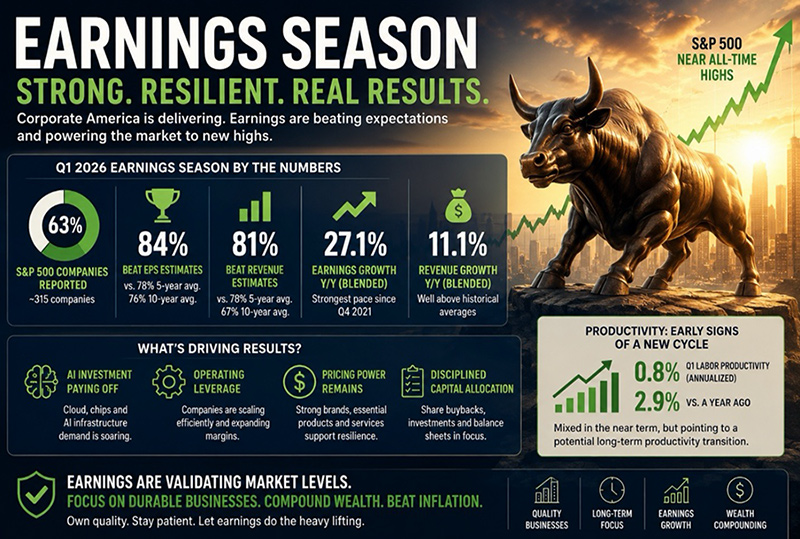
As of the latest FactSet update, 63% of S&P 500 companies have reported Q1 2026 results, or roughly 315 companies. The season has been very strong: 84% have beaten EPS estimates, above the 5-year average of 78% and 10-year average of 76%; 81% have beaten revenue estimates, above the 5-year average of 70% and 10-year average of 67%. Blended S&P 500 earnings growth is tracking around 27.1% year-over-year, the strongest pace since Q4 2021, while revenue growth is tracking around 11.1%, also well above historical averages.
This matters because over time, earnings—not headlines—determine market direction. When businesses consistently generate higher profits, reinvest capital efficiently, and expand cash flows, they naturally justify higher valuations. That is exactly what we are seeing today. Despite concerns about inflation, the companies leading the index, particularly in technology, infrastructure, healthcare, and industrials, are proving they can outgrow inflation through pricing power, productivity gains, and scale advantages.
This is where the concept of investing in durable, growing businesses becomes so powerful. Inflation erodes purchasing power, but companies with strong competitive positions can offset that erosion by raising prices, improving efficiency, or capturing greater market share. Over time, their earnings compound at a rate that exceeds inflation, and shareholders participate in that compounding. Simply put, owning the right businesses is one of the most effective ways to preserve and grow real wealth.
History reinforces this point. Periods like the late 1990s or mid-2000s were not defined solely by macro conditions, but rather they were defined by companies that could grow through them. Today’s environment shares similarities. We are in the early stages of a capital investment cycle driven by AI, infrastructure, and energy demand. That investment may look expensive upfront, but it is laying the groundwork for future productivity gains and sustained earnings growth.
For long-term investors, the takeaway is straightforward: while markets will always react to short-term uncertainty, wealth is built by staying aligned with businesses that can compound earnings over time. The current earnings season is a reminder that, even in a noisy environment, the underlying engine of corporate America remains strong—and that strength is ultimately what supports both market levels and long-term portfolio growth.
One of our Research Affiliates, Evercore ISI, authored a great report titled “Sizing (Up) the Bull Run – 1982 Momentum Meets 2026 Macro”. If anyone is interested in reading, just reply to this email and we will forward it to you.
Individual Company Updates
Alphabet delivered a standout quarter that reinforced the view that its aggressive AI investments are translating into real earnings power. Revenue grew 22% year-over-year to $109.9 billion, while operating income rose 30% and margins expanded to 36.1%, driving an 82% surge in adjusted EPS. Google Cloud remains the centerpiece of the growth story, with revenue up 63% and operating income tripling as enterprise AI demand continues to outpace available capacity. The company’s full-stack AI strategy, including its custom TPU infrastructure, is driving efficiency and strengthening its competitive position. Importantly, core Search remains resilient, growing 19% despite disruption concerns, while YouTube and subscription businesses continue to expand. With capex ramping toward $180–190 billion annually, the narrative has shifted from questioning AI spend to recognizing Alphabet’s ability to convert that investment into sustained growth and profitability.
Amazon’s blowout quarter helped settle the debate around its nearly $200 billion AI investment cycle, showing clear evidence that the company is building long-term competitive advantage rather than overinvesting. Revenue grew 17% to $181.5 billion, operating income rose 30%, and EPS climbed nearly 75%, with margins reaching record levels. AWS continues to be the primary driver, accelerating to 28% growth with a backlog exceeding $360 billion, reflecting strong enterprise AI demand and multi-year visibility. AI-related usage is scaling rapidly, with Bedrock adoption and custom silicon deployment improving both cost structure and performance. Across the broader business, retail and advertising remain strong contributors. While capex is pressuring near-term free cash flow, the alignment between investment, demand, and early monetization suggests a clear path toward future margin expansion and cash flow growth.
Eli Lilly continues to demonstrate powerful earnings momentum, driven primarily by its leadership in the GLP-1 obesity and diabetes market. Demand for its flagship therapies remains exceptionally strong, with supply constraints still limiting full revenue potential. Beyond its metabolic franchise, Lilly’s pipeline in oncology and neuroscience continues to add long-term optionality. Margins remain robust despite ongoing investments in manufacturing expansion, as the company scales capacity to meet global demand. With strong pricing power, durable growth drivers, and one of the most compelling pipelines in healthcare, Lilly remains a premier example of a company compounding earnings well above inflation.
Microsoft reported strong results that confirmed its leadership in enterprise AI, though the lack of a clear upside surprise kept investor reaction muted. Revenue grew 18% to $82.9 billion, with Azure up 40% and Microsoft Cloud revenue rising 29%. AI adoption continues to scale rapidly, with AI-related annual recurring revenue surpassing $37 billion and Copilot usage expanding across the enterprise. The company’s backlog and remaining performance obligations highlight strong forward demand, providing significant visibility into future growth. However, heavy capex—expected to approach $190 billion—continues to pressure near-term margins and free cash flow, creating a timing gap between demand and financial realization. While the long-term positioning remains compelling, near-term sentiment will depend on how quickly AI adoption translates into sustained profitability.
Arm sits at the center of the AI and computing ecosystem, benefiting from its licensing model that scales across mobile, cloud, and increasing data center workloads. The company is seeing accelerating demand for its next-generation architectures as hyperscalers design custom silicon optimized for AI and energy efficiency. Royalty revenue is rising as more advanced chips incorporating Arm designs move into production, creating a powerful recurring revenue stream. While valuation remains elevated, the structural shift toward custom silicon and power-efficient computing continues to expand Arm’s addressable market, positioning it as a foundational layer in the global AI buildout.
NextEra Energy remains one of the most strategically positioned utilities in the U.S., leveraging its leadership in renewable energy and grid infrastructure to benefit from rising electricity demand. The acceleration of AI data centers and electrification trends is driving a step-change in power consumption, creating long-term growth opportunities for regulated utilities and generation assets. NextEra’s pipeline of renewable projects, combined with its scale in transmission and storage, supports steady earnings growth with relatively low volatility. While interest rate sensitivity can create near-term pressure, the long-term story is increasingly tied to its role as a critical supplier of reliable, scalable power in an energy-constrained environment.
Eaton continues to emerge as a key beneficiary of the global electrification and data center expansion cycle. Demand across its electrical segments remains robust, driven by hyperscale data center buildouts, grid modernization, and industrial automation. The company is seeing strong order growth and backlog expansion, providing clear visibility into future revenue. Margins are improving as Eaton scales its higher-value electrical solutions and benefits from operating leverage. With AI infrastructure driving incremental demand for power distribution, protection, and efficiency, Eaton is increasingly viewed as a “picks-and-shovels” provider in the AI ecosystem, translating structural demand into durable earnings growth.
JPMorgan continues to demonstrate the strength of its diversified business model, delivering consistent earnings supported by solid net interest income, strong capital markets activity, and resilient consumer trends. The bank benefits from its scale and balance sheet strength, allowing it to navigate a higher-rate environment more effectively than peers. Credit quality remains stable, while investment banking and trading activity are showing signs of improvement as market conditions normalize. Importantly, JPM continues to invest in technology and efficiency, reinforcing its competitive advantage. In a more uncertain macro environment, the company stands out as a high-quality financial institution capable of generating durable returns across cycles.
ASE Technology continues to benefit from the AI-driven semiconductor infrastructure cycle, delivering strong results that extended its momentum. Revenue grew 17% year-over-year, driven by a 30% surge in advanced packaging demand, while EPS rose nearly 80%. The company highlighted capacity constraints as a limiting factor, underscoring the strength of demand across AI-related chip production. With new capacity coming online later in 2026, ASE remains well positioned to capture continued growth in advanced packaging, a critical bottleneck layer in the semiconductor ecosystem.
EMCOR delivered a blowout quarter, highlighting its central role in the buildout of data centers and critical infrastructure. Revenue rose nearly 20% to $4.15 billion, while EPS jumped 30% and margins expanded. Demand remains broad-based across data centers, healthcare, and manufacturing, supported by a record backlog and strong project pipeline. With a book-to-bill ratio of approximately 1.5x and raised full-year guidance, EMCOR continues to demonstrate sustained visibility into future growth, driven by long-cycle infrastructure and electrification demand.
Amphenol delivered exceptional results, reinforcing its position as a key enabler of the global electronics and AI infrastructure cycle. Revenue surged 58% year-over-year, with EPS up 68% and record orders driving a strong backlog. Growth was led by IT datacom demand, reflecting the surge in AI-related connectivity needs. Margins expanded meaningfully, supported by scale and operational execution, while continued acquisitions and innovation broaden the company’s reach. With strong forward guidance, Amphenol remains a core beneficiary of the ongoing high-performance electronics cycle.
MasTec posted one of the strongest quarters in its history, driven by accelerating demand across energy, infrastructure, and data center connectivity. Revenue rose 34%, EBITDA surged 73%, and EPS more than doubled, supported by strength in pipeline, clean energy, and infrastructure segments. The company’s record backlog highlights multi-year visibility tied to AI-driven power demand, grid modernization, and fiber expansion. With raised guidance and strong cash flow expectations, MasTec is emerging as a key infrastructure beneficiary of the AI and energy investment cycle.
nVent delivered record results, reflecting its growing role in power infrastructure and data center buildouts. Revenue increased more than 50%, with EPS up over 60%, driven by strong demand across infrastructure, utilities, and data centers. Orders and backlog continue to expand, providing visibility into sustained growth. The company’s balance sheet remains strong, supporting continued investment and acquisitions. With raised guidance and accelerating organic growth, nVent is well positioned within the electrification and AI-driven power demand theme.
Labcorp reported another steady quarter, with revenue and earnings growth supported by strong demand across its diagnostics and laboratory services business. The company continues to generate consistent cash flow while investing in acquisitions and returning capital to shareholders. With raised guidance and ongoing institutional accumulation, Labcorp remains a stable healthcare compounder with defensive characteristics.
ATI delivered strong results driven by aerospace and defense demand, with margins expanding and earnings growth outpacing expectations. The company’s backlog reached record levels, reflecting sustained demand for high-performance materials. With raised guidance across key metrics, ATI continues to benefit from long-cycle defense and aerospace tailwinds.
Sterling Infrastructure delivered exceptional results, with revenue nearly doubling and earnings more than doubling as demand for data center and mission-critical infrastructure accelerated. Backlog expanded significantly, supported by strong project activity and recent acquisitions. With a substantial guidance increase and continued momentum, Sterling is emerging as a key beneficiary of infrastructure spending tied to AI and electrification.
Pfizer delivered a clean earnings beat, driven by strong execution across its portfolio and growth in recently launched products. The company reaffirmed full-year guidance, signaling confidence in its pipeline and commercial strategy. While growth remains more measured compared to peers, Pfizer continues to generate stable cash flow and maintain its position as a large-cap pharmaceutical leader.
Arista delivered strong revenue and earnings growth, supported by surging demand for AI networking infrastructure. However, the stock pulled back as investors focused on margin compression driven by supply chain constraints and elevated component costs. Despite near-term pressure, the company’s expanding role in AI networking and strong demand outlook continue to support long-term growth.
Walmart continues to execute exceptionally well in a challenging consumer environment, leveraging its scale and value positioning to gain market share across income cohorts. The company is benefiting from strong traffic trends, growth in grocery and essentials, and continued expansion in high-margin segments such as advertising and e-commerce fulfillment services. Walmart’s ability to balance price leadership with margin discipline highlights its operational strength, while investments in automation and supply chain efficiency are driving productivity gains. As consumers remain price-sensitive, Walmart’s model positions it as both a defensive and steadily growing business in the current environment.
Formidable Asset Management (“Massey Romans Capital”) is an investment adviser registered under the Investment Advisers Act of 1940. The information presented in the material is general in nature and is not designed to address your investment objectives, financial situation or particular needs. Prior to making any investment decision, you should assess, or seek advice from a professional regarding whether any particular transaction is relevant or appropriate to your individual circumstances. Although taken from reliable sources, the Firm cannot guarantee the accuracy of the information received from third parties.
The opinions expressed herein are those of the Firm and may not actually come to pass.
Author
Paul MasseyRelated posts
In the Loop – September 4, 2026
This weekend marks the unofficial end of summer with a day off on Monday for Lab
In the Loop – April 17, 2026
Markets hit all-time highs as consumer sentiment nears 80-year lows. Explore the
In the Loop – February 21, 2025
Starting today, every Friday we will send out a short update reflecting major de