



In the Loop – May 29, 2026
“In The Loop” is designed to give you a short update reflecting major developments, earnings, and investment trends across some core Equity Income and Growth holdings. All clients should be aware that individual buy/sell recommendations will be conveyed directly to you on an individual basis. Have a great weekend.
I know in a couple of weeks everyone will want to talk about SpaceX, so for now I’m going to kick the can for another day. I want to give you some brief updates and then discuss what’s really driving this economy and the markets.
It is no secret that the Iran Conflict has caused the price of Oil to rise, which in turn has caused inflation expectations to rise causing interest rates to move higher. These factors seem to fall everytime peace in the Middle East or The Strait of Hormuz opening comes across our TV’s. If 10-year Treasury yields remain above 5% and oil remains above $100 per barrel well beyond July 4th, the market narrative likely shifts from a temporary geopolitical shock to a more persistent inflation and economic growth challenge. Historically, sustained combinations have often preceded economic slowdowns or recessions. However, if oil falls toward $80 and the 10-year Treasury drifts toward 4%, the market would likely view it as evidence that inflation is easing without a recession. Historically, that environment favors broader equity participation, multiple expansion, housing activity, AI infrastructure, and high-quality growth companies. Our opinion, the administration knows this and will keep it in check.
A stable 4%–5% 10-year Treasury environment is very different from the near-zero rate world that defined much of the 2010–2021 period, yet it is also far healthier than a disorderly spike in rates. Markets can adapt to “higher but stable” rates, and in many ways this environment favors businesses with durable earnings, strong free cash flow, pricing power, domestic investment exposure, and tangible economic utility. Investors begin prioritizing companies that can self-fund growth through cash generation rather than relying on cheap external capital, shifting leadership away from “growth at any price” and toward cash-flow compounders. At the same time, higher nominal growth and ongoing reshoring trends increase the importance of infrastructure and industrial investment, benefiting areas tied to electricity, transformers, cooling, LNG, semiconductors, automation, and data centers—key pillars of the “US Resiliency” framework. Companies often benefit from long-cycle capex, multi-year backlogs, and constrained skilled capacity. Stable higher rates also restore the appeal of dividend growth, quality industrials, utilities, pipelines, insurers, and financials, as stocks once again must compete with attractive bond yields. Banks and insurers can structurally improve through stronger lending spreads and higher reinvestment yields, while speculative “narrative-only” businesses often struggle as markets become less forgiving toward dilution, leverage, and distant profitability. Historically, this resembles periods such as the mid-1990s or parts of 2003–2007, where leadership shifted toward productive assets, infrastructure, industrial demand, and profitable innovation. That is also why today’s AI buildout differs from many speculative bubbles of 2021: hyperscaler spending is backed by real cash flow, customers are signing multi-year commitments, and infrastructure demand is physical and monetizable rather than purely conceptual. In today’s market, investors are increasingly rewarding growth that is real, durable, and cash-generating, not just a compelling story.
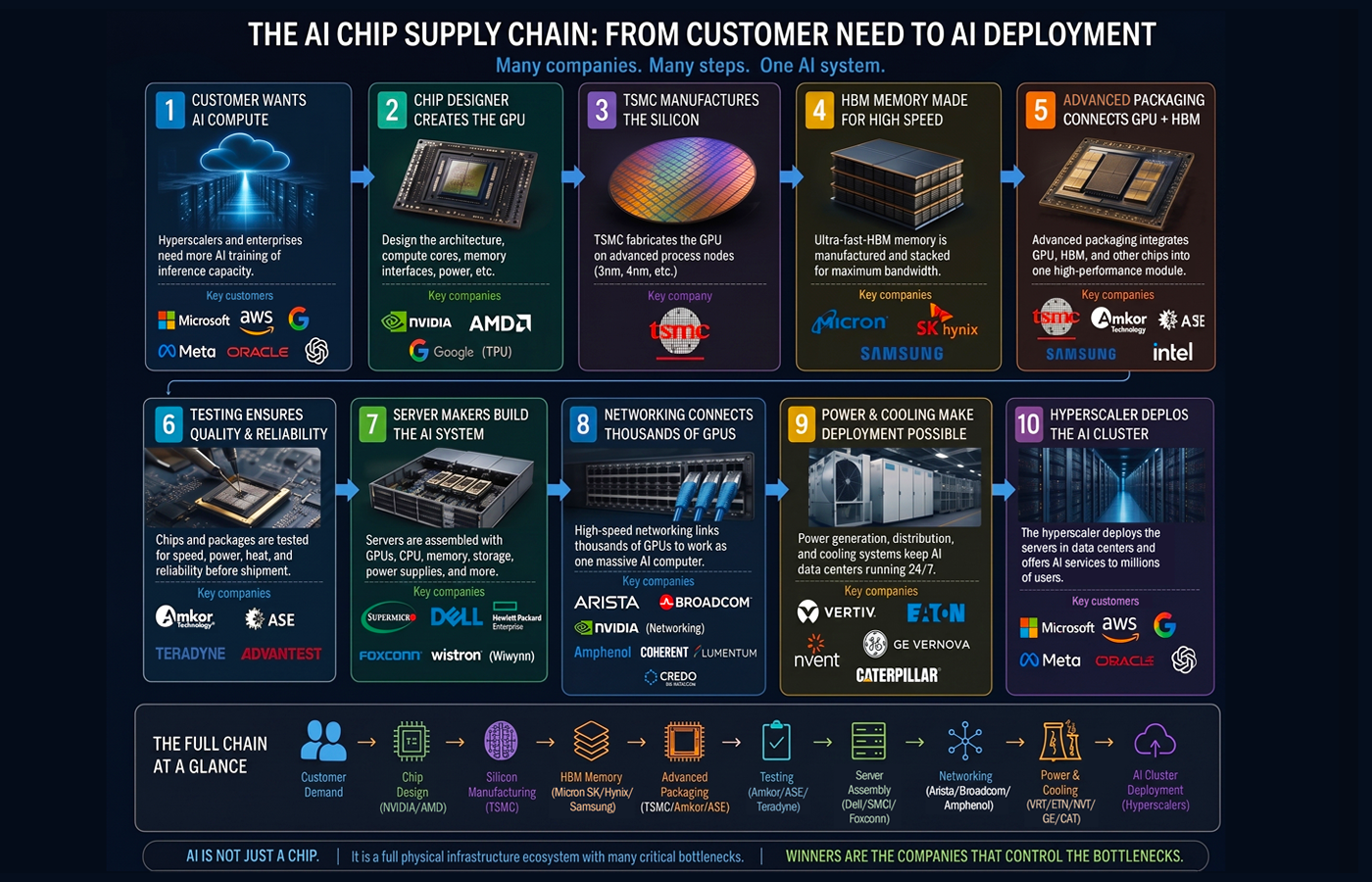
Today I want to explain the supply chain so you can understand how many companies within different industries it takes to create One AI system. It’s not just a chip. It’s a full physical infrastructure ecosystem with many critical bottlenecks, and this is where our team is finding Winners!
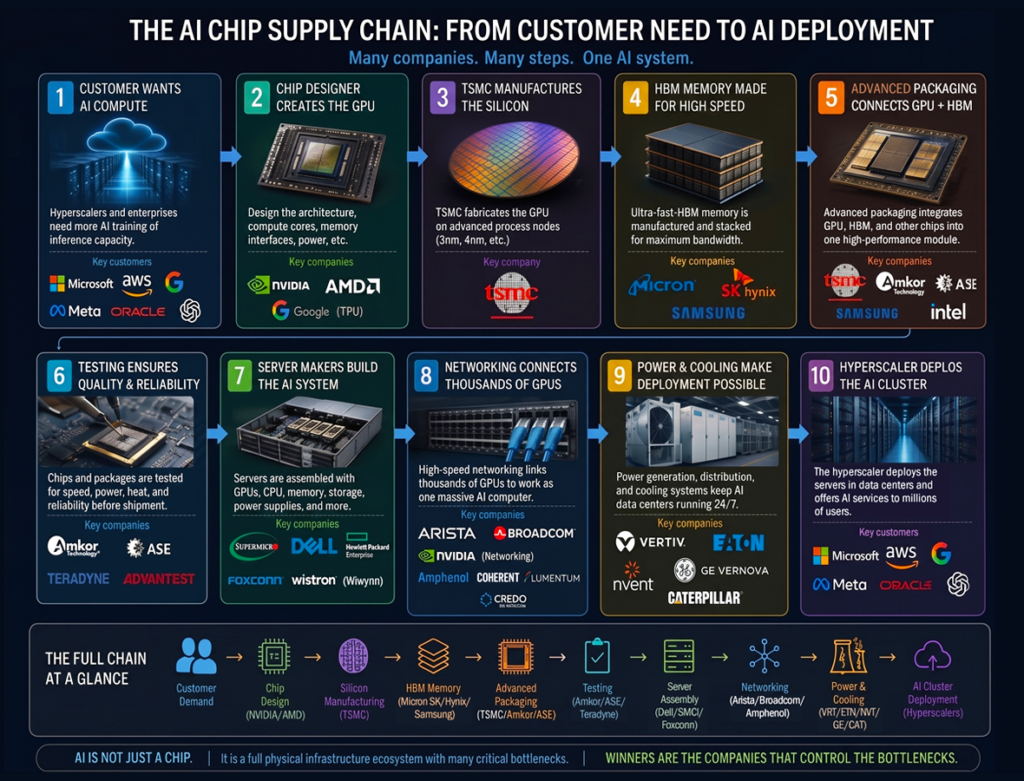
To summarize the diagram above:
1. Customer wants AI compute
“We need faster AI training/inference capacity.”
2. Chip designer creates the GPU
Nvidia designs the GPU, but Nvidia does not manufacture most of it itself.
3. TSMC manufactures silicon
Think of TSMC as the world’s most advanced chip factory. Nvidia designs the “brain.” TSMC manufactures the “brain tissue.”
4. Micron makes the HBM (High Bandwidth Memory)
HBM is stacked memory that sits very close to the GPU so the chip can process AI models faster. Without HBM, the GPU is like a race car with a tiny fuel line.
5. Advanced packaging connects GPU + HBM
This turns separate parts into one usable AI accelerator. This is why packaging matters: the GPU is not finished until it is packaged with memory. This is the bottleneck layer.
6. Testing makes sure it works.
AI chips are expensive. You cannot ship defective ones.
7. Server makers assemble the full AI system. Now the chip becomes a server.
8. Networking connects thousands of GPUs.
Without networking, the GPUs cannot act as one giant AI computer.
9. Power and cooling make deployment possible.
AI servers use huge electricity and create huge heat. Even if the chip is ready, the data center may not be. Bottleneck
10. Hyperscalers deploy the AI Clusters
The key transition is happening now. It’s less about “Rent servers and storage” and more about “Rent intelligence and compute power.” That is why AI is no longer just a semiconductor story. It is a full physical infrastructure story.
We are building the modern age digital utility company operating the AI industrial infrastructure of the future.
Individual Company Updates
Teledyne continues to benefit from several long-term growth trends across aerospace, defense, industrial automation, and space technologies. Demand remains strong for its high-performance sensors, imaging systems, and instrumentation products, particularly in defense modernization, autonomous systems, and satellite applications. The company’s growing exposure to space-based intelligence, surveillance, and reconnaissance programs positions it well as governments increase spending on national security and resilient communications networks. While not typically viewed as a high-profile AI company, Teledyne provides many of the critical sensing and imaging technologies that enable advanced defense and industrial systems, creating a durable and diversified growth profile.
Arista remains one of the primary beneficiaries of the AI infrastructure buildout as hyperscale cloud providers continue investing heavily in next-generation data centers. The company’s high-speed Ethernet networking solutions play a critical role in connecting thousands of GPUs and AI accelerators within large-scale computing clusters. Management continues to report strong demand from cloud and AI customers, while expanding its footprint in enterprise networking and campus infrastructure. As AI workloads grow larger and more complex, networking increasingly becomes a critical bottleneck, positioning Arista as one of the key “picks and shovels” providers supporting the AI ecosystem.
Credo remains one of the more specialized beneficiaries of the AI infrastructure cycle, focusing on high-speed connectivity solutions that enable efficient movement of data between servers, switches, and AI processors. The company continues to gain traction with hyperscale customers seeking to improve power efficiency and bandwidth within rapidly expanding AI data centers. Investor enthusiasm remains tied to the company’s ability to secure larger deployments across next-generation networking architectures. If AI infrastructure spending remains elevated over the next several years, Credo’s connectivity technologies could become increasingly important as data transfer speeds and power efficiency emerge as critical constraints within large-scale AI systems.
Broadcom continues to solidify its position as one of the most important infrastructure companies in the AI ecosystem. The company benefits from demand across custom AI accelerators, networking silicon, optical connectivity, and enterprise software. Its partnerships with major hyperscalers have expanded significantly as cloud providers increasingly pursue custom chip strategies alongside traditional GPU deployments. Broadcom’s networking portfolio remains critical for enabling large-scale AI clusters, while its software business provides recurring cash flow that supports continued investment and shareholder returns. With AI infrastructure spending expected to remain a multi-year priority for cloud providers, Broadcom remains one of the most strategically positioned companies across both hardware and software layers of the AI value chain.
Formidable Asset Management (“Massey Romans Capital”) is an investment adviser registered under the Investment Advisers Act of 1940. The information presented in the material is general in nature and is not designed to address your investment objectives, financial situation or particular needs. Prior to making any investment decision, you should assess, or seek advice from a professional regarding whether any particular transaction is relevant or appropriate to your individual circumstances. Although taken from reliable sources, the Firm cannot guarantee the accuracy of the information received from third parties.
The opinions expressed herein are those of the Firm and may not actually come to pass.
Author
Paul MasseyRelated posts
In the Loop – June 12, 2026
Investors are understandably excited about the potential public offerings of sev
In the Loop – July 10, 2026
History continues to provide a constructive backdrop for the second half of the
In the Loop – October 16, 2026
For the past three years, investors have been focused on the enormous opportunit