



In the Loop – August 21, 2026
“In The Loop” is designed to give you a short update reflecting major developments, earnings, and investment trends across some core Equity Income and Growth holdings. All clients should be aware that individual buy/sell recommendations will be conveyed directly to you on an individual basis. Have a great weekend.
Our internal probability-weighted assessment assigns approximately 33% of the market’s direction over the coming year to corporate earnings and capital spending, 30% to the Fed’s new policy framework, 14% to geopolitical developments and energy prices, 13% to fiscal policy and Treasury borrowing, 6% to the midterm elections and related regulatory changes, and 4% to valuation, positioning and other technical factors. These percentages are not intended to suggest false precision. They represent our estimate of each factor’s relative influence across the full twelve-month period. With the Fed’s likely new Policy Framework ranked so high, we wanted to spend more time today explaining our views on this matter.
The 2026 Jackson Hole Economic Policy Symposium will be held from Thursday, August 27, through Saturday, August 29, at Jackson Lake Lodge in Wyoming. Hosted annually by the Federal Reserve Bank of Kansas City, this invitation-only gathering brings together approximately 120 central bankers, policymakers, economists, academics, financial-industry leaders and select members of the media.
This year’s theme, “Financial Innovation: Implications for Payments and Policy,” will examine how new technologies are changing the movement of money and potentially reshaping monetary policy and financial regulation. Stablecoins, tokenized assets, real-time payment systems, central bank digital currencies and the expanding role of private financial platforms are all likely to be part of the discussion. Although the complete agenda has not yet been released, Friday is traditionally the most market-sensitive session and is expected to feature Fed Chair Kevin Warsh’s principal address.
As strategists, our responsibility is not to forecast the outcome we would prefer, but to identify the outcome the available evidence suggests is most probable. With that in mind, Jackson Hole may be less about whether Warsh sounds conventionally hawkish or dovish and more about how he intends to change the Fed’s decision-making process.
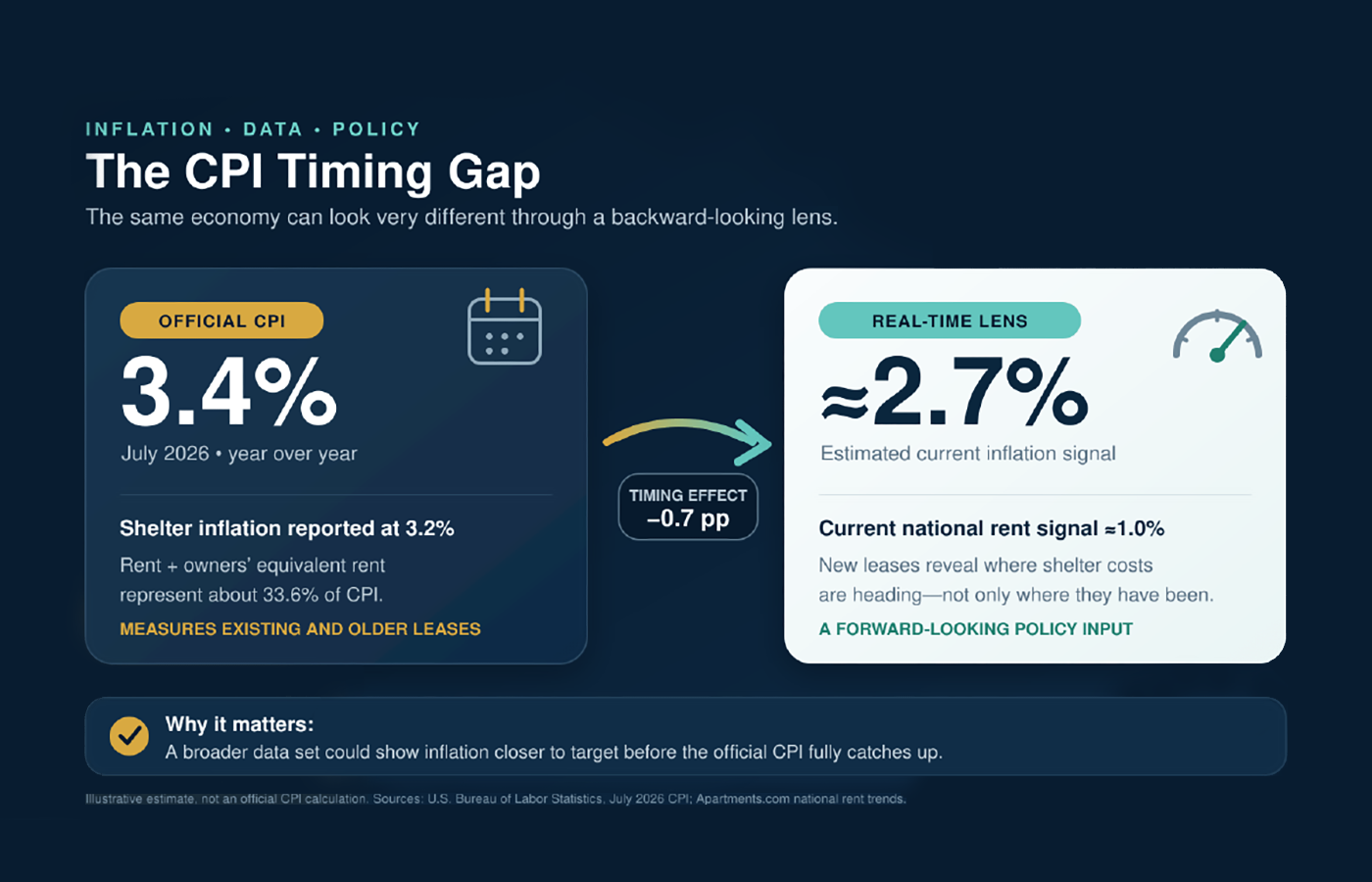
Every central bank has what economists call a reaction function—the method it uses to translate economic information into policy decisions. Warsh may ultimately respond to inflation and employment in a relatively traditional manner, but he could place greater emphasis on a different and broader collection of inputs. Instead of relying too heavily on backward-looking government reports, the Fed could incorporate more timely measures of housing costs, wages, credit conditions, business activity and market-based information. The meaningful change may therefore come from the data entering the process rather than the formula applied afterward.
Warsh must also address inflation without treating every increase in prices as though it has the same cause or requires the same remedy. Inflation clearly damages purchasing power, particularly when household income fails to keep pace. Nevertheless, inflation should be evaluated alongside wage growth, productivity and real returns rather than viewed in isolation. The Fed’s 2% objective provides an important anchor, but policymakers must still determine whether a particular inflationary episode reflects excessive demand, constrained supply or a temporary external shock.
That distinction matters because higher interest rates cannot solve every form of inflation. If energy prices rise because of geopolitical conflict and restricted supply, raising borrowing costs will not reopen shipping lanes or immediately increase production. It could instead make it more expensive for energy companies to finance the additional capacity needed to relieve the shortage. A similar problem applies to the enormous investment underway in artificial intelligence, data centers and domestic infrastructure. A modest rate increase is unlikely to stop the largest and most economically attractive projects, but it could place additional pressure on housing, small businesses and other interest-rate-sensitive parts of the economy.
This suggests that Warsh may resist raising rates simply because a headline inflation measure remains above target. He could argue that policymakers must first identify the source of the price pressure and determine whether monetary tightening can realistically address it. That would not represent indifference toward inflation. It would reflect a more targeted assessment of whether the proposed policy response is capable of solving the underlying problem without causing unnecessary damage elsewhere.
Jackson Hole may also provide Warsh with an opportunity to begin reconsidering the Fed’s broader institutional framework. The central bank’s balance sheet, inflation methodology and economic data sources are all candidates for review. Quantitative easing was originally designed as an emergency measure, yet it gradually became a routine policy instrument. Examining when balance-sheet intervention is truly necessary—and when the announcement of support may be sufficient—could lead to a more disciplined and limited approach.
Our base case is that Warsh uses Jackson Hole to establish credibility on inflation while opening the door to a substantial modernization of the Fed. He is unlikely to abandon the 2% goal, but he may challenge the idea that every above-target reading requires an automatic rate increase. If he emphasizes the source of inflation, improved data and a more disciplined balance-sheet policy, expectations for another near-term rate hike could continue to decline.
That does not necessarily mean long-term interest rates will fall by the same amount. Heavy Treasury issuance, expanding defense and infrastructure budgets, continued corporate borrowing and reduced demand from some traditional foreign buyers could keep pressure on the longer end of the yield curve. The result could be a Fed that is patient with short-term rates while the bond market independently demands greater compensation for inflation, fiscal risk and the growing supply of debt.
For investors, the larger message would be that monetary policy is becoming less predictable and potentially less supportive of financial markets. That environment should favor companies with strong current earnings, durable free cash flow, pricing power and manageable leverage. It would also reinforce our preference for the physical beneficiaries of the domestic investment cycle—power generation, the electrical grid, energy infrastructure, defense, industrial automation and the essential equipment supporting the AI buildout. In other words, Jackson Hole could further confirm the transition from liquidity-driven market gains toward a period in which cash flow, execution and balance-sheet strength matter considerably more.
Our role as strategists is to assess what is most likely to happen, not advocate for the outcome we would prefer. If our interpretation of Warsh’s developing policy framework is correct, it could become one of the two most important forces influencing markets over the next year.
The framework’s significance extends beyond whether the Fed raises or lowers interest rates. It could change how investors interpret economic information, how much confidence they place in forward guidance and how much support they expect from the central bank during periods of market weakness. A Fed that relies on broader, more timely data, intervenes less frequently and refuses to respond automatically to every inflation report would produce a more data-sensitive and less predictable investment environment.
This is how we determined our probability weights. To restate, this is NOT precision, but rather our current thoughts.
We place earnings first because profits ultimately provide the foundation for sustainable stock-market gains. Corporate results remain unusually strong, supported by artificial intelligence investment, energy spending, defense demand and domestic infrastructure construction. If earnings continue rising, the market can withstand some pressure from higher interest rates. However, strong earnings will not protect every company equally. Businesses whose valuations depend primarily on distant future profits will remain much more sensitive to changes in discount rates than companies already producing substantial cash flow.
The Fed framework ranks a close second, with roughly a 30% probability of becoming the market’s single most important driver and approximately a 70% probability of ranking among the top two. “Our Opinion” Its influence will be greatest through valuation rather than immediate changes in economic activity. A less accommodative Fed could limit multiple expansion even while earnings continue growing. It may also remove some of the confidence behind the traditional “Fed put,” increasing volatility when markets encounter disappointing data or geopolitical shocks.
This policy approach could produce an unusual divergence in the bond market. If Warsh concludes that supply-driven inflation does not justify additional tightening, expectations for short-term rate increases may decline. Long-term yields, however, could remain elevated because of persistent federal deficits, heavy Treasury issuance, infrastructure and defense spending, and reduced participation from some traditional foreign buyers. The result could be a steeper yield curve rather than a broad decline in interest rates.
That environment would have important consequences for market leadership. Banks and selected financial companies could benefit from a steeper curve, while heavily leveraged businesses, speculative growth companies and interest-rate-sensitive real estate would face greater pressure. Companies with strong balance sheets, current earnings, pricing power and reliable free cash flow should command a premium. Market returns are also likely to become more dependent on individual company execution, producing greater dispersion between winners and losers.
The new framework could further widen the divide between the two speeds of the economy. A modest rate increase is unlikely to stop strategically important investments in artificial intelligence, power generation, defense or domestic manufacturing. “U.S. Resiliency”. Sorry, I had to add it. The expected returns and national importance of those projects are simply too large. Higher borrowing costs would have a much greater effect on housing, small businesses, commercial real estate and lower-income consumers. Monetary tightening could therefore slow down the weaker parts of the economy without materially reducing investment in the strongest areas.
Geopolitics remains the factor most capable of temporarily overwhelming every other influence. An escalation affecting energy production, shipping routes or global supply chains could quickly push inflation and bond yields higher. However, geopolitical events usually require sustained economic consequences to control markets for an entire year. Elections are likely to generate short-term volatility as investors evaluate potential changes in taxes, spending and regulation, but their lasting importance will depend on whether the results materially alter fiscal policy.
Our base case is for positive but more uneven market returns over the next twelve months. Earnings growth should provide support, but elevated long-term yields and a less market-friendly Fed could restrain valuations. We would expect periodic corrections, wider performance differences among companies and continued rotation toward businesses that can convert the current investment cycle into actual revenue, earnings and cash flow.
For our strategy, this reinforces the move from liquidity-driven gains toward cash-flow-driven returns. We continue to favor the physical beneficiaries of the domestic capital-spending cycle—power generation, the electrical grid, energy infrastructure, defense, industrial automation and the equipment enabling AI development. If the Warsh framework develops as expected, balance-sheet strength and execution will become increasingly important, while reliance on inexpensive capital and expanding valuation multiples will become considerably less dependable.
Since this is so long today, I will spend more time next week updating you on our holdings.
Have a great weekend.
Formidable Asset Management (“Massey Romans Capital”) is an investment adviser registered under the Investment Advisers Act of 1940. The information presented in the material is general in nature and is not designed to address your investment objectives, financial situation or particular needs. Prior to making any investment decision, you should assess, or seek advice from a professional regarding whether any particular transaction is relevant or appropriate to your individual circumstances. Although taken from reliable sources, the Firm cannot guarantee the accuracy of the information received from third parties.
The opinions expressed herein are those of the Firm and may not actually come to pass.
Author
adminRelated posts
In the Loop – November 14, 2025
Spending Veteran’s Day at the New York Stock Exchange supporting our friends a

Growth Stocks Continue to Win in 2023
“Skate to where the puck is going, not to where it has been”, Wayne Gretzky.
In the Loop – May 15, 2026
The past week in the markets highlighted a renewed focus on geopolitics, monetar