



In the Loop – July 24, 2026
“In The Loop” is designed to give you a short update reflecting major developments, earnings, and investment trends across some core Equity Income and Growth holdings. All clients should be aware that individual buy/sell recommendations will be conveyed directly to you on an individual basis. Have a great weekend.
98 S&P 500 companies have reported 2Q results. Reported Sales growth has been +15.3% and Earnings +36.8% – surprising by +3.0% and +10.9% – putting overall Sales growth on pace for +12.8% and Earnings for +25.0%. Extrapolating Evercore ISI expected +3.3% surprises to the balance of companies reporting suggests Earnings +27.9%. Excellent overall results. However, the average stock price fell -0.4% post-results.
This is one of the most interesting earnings seasons we’ve seen in years because the fundamentals and the stock reactions tell two different stories. The data implies that the economy is stronger than many investors expected, but the market has already discounted much of that strength. Normally, those earnings statistics would produce strong post-earnings gains. Instead, companies are beating expectations by double digits, and the average stock is declining.
That tells us the market has shifted from “Are earnings good?” to “Are they good enough?”
- The economy is stronger than consensus.
- Expectations have become extremely high.
- Valuation is beginning to matter again.
- Leadership is narrowing
When average earnings reactions are negative despite excellent reports, money usually rotates toward: highest conviction names, lowest valuation relative to growth, companies with accelerating revisions and companies where expectations remain modest. Rather than lifting the entire market. This creates a much better stock picker’s environment.
Historically this type of setup often leads to one of three outcomes.
Earnings catch up to valuations
The market goes sideways while earnings continue growing.
Instead of a correction in prices……time becomes the correction.
This is probably the healthiest outcome.
Rotation beneath the surface
The index makes only modest progress.
Leadership broadens.
Money rotates into: Industrials, Financials, Power, Infrastructure and Healthcare. As well as select small- and mid-cap companies.
Expectations finally break
If several mega-cap companies fail to justify their valuations over the next two quarters: multiples compress, earnings remain good, index corrects 10-15%.
Importantly…
This would likely be a valuation correction, not an earnings recession.
Those are very different markets.
Oil has reemerged as a critical macro risk at the same time the AI economy is becoming increasingly dependent on abundant, reliable energy. Brent crude surged from roughly $71 per barrel in early July to nearly $95 by July 22 as escalating tensions with Iran, the effective closure of the Strait of Hormuz, and threats to shipping through the Red Sea raised the possibility of disruptions across multiple energy chokepoints. The concern is amplified by the depleted U.S. Strategic Petroleum Reserve, which has fallen to approximately 311 million barrels—its lowest level since 1983. The United States is not running out of oil, but policymakers now have a much smaller cushion to soften a prolonged supply shock. For investors, this reinforces the importance of energy security within the AI capital-spending cycle: data centers, semiconductor plants, construction projects, and automated factories all require dependable power, making domestic oil and gas production, pipelines, storage, backup generation, and grid infrastructure increasingly strategic assets.
We do not believe there is currently broad support within the Federal Open Market Committee for an immediate rate increase, although Chair Warsh would likely have enough votes to tighten policy if he judged it necessary. Our expectation is that he will follow a two-stage strategy: first reinforcing the Fed’s inflation-fighting credibility and maintaining policy discipline, then shifting attention toward institutional reform, the size and composition of the balance sheet, and a longer-term economic framework increasingly shaped by AI-driven productivity and investment. The task forces he has established could help support that transition by giving the Fed a more structured way to evaluate how technological change may influence growth, inflation, labor markets, and future monetary policy.
Action Plan
Stay with companies where spending is non-discretionary.
Bottom Line
It’s a complicated picture with the Iran War back on the table, new announced tariffs, 10 yr Treasury yields climbing to 4.7%, Oil back over $90, 30 Year Mortgage Rates at 6.85% and Gas above $4. However, as these issues resolve themselves, we will focus back on strong earnings, and growth will regain momentum.
This earnings season does not look like the beginning of an economic slowdown. It looks more like the transition from an expectation-driven bull market to a fundamental-driven stock picker’s market. Corporate America is producing exceptional results, but investors are demanding even more because valuations already reflect much of that strength. Over the next three to six months, I would expect slower index returns, greater dispersion between winners and losers, and a broader rotation toward companies with durable earnings growth, strong free cash flow, and reasonable valuations. In that environment, disciplined security selection should matter more than simply owning the market index.
I am going to end with a chart and will cover more companies in the next two weeks as we analyze individual company results.
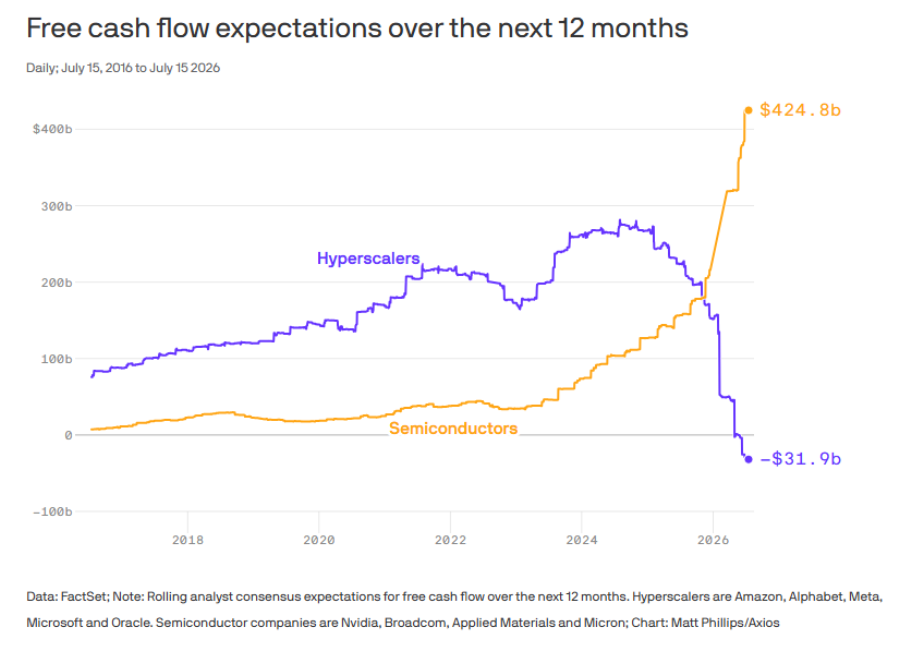
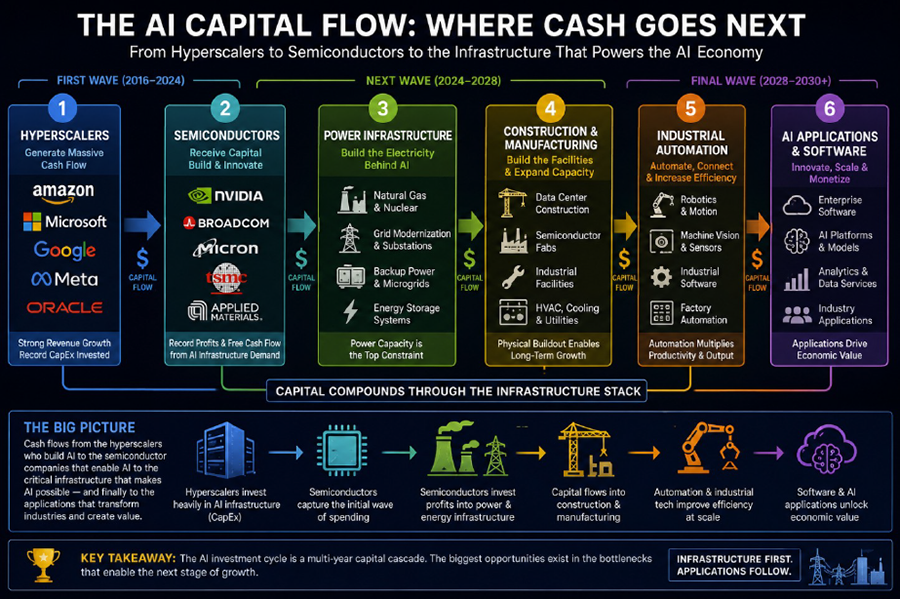
Hyperscalers (GOOGL, AMZN, META) are spending the money, semiconductors (NVDA, MU, AVGO) are collecting the money. However, the real question is where the semiconductor companies will spend the newfound cash flow. Our research identified that it first went to build capacity (ASML, TSM) to meet demand and now its flowing to all things power. There will be lots of opportunities within the infrastructure space over the coming years.
Our favorite sectors are Technology, Financials, Industrials and Healthcare. Have a great weekend.
Formidable Asset Management (“Massey Romans Capital”) is an investment adviser registered under the Investment Advisers Act of 1940. The information presented in the material is general in nature and is not designed to address your investment objectives, financial situation or particular needs. Prior to making any investment decision, you should assess, or seek advice from a professional regarding whether any particular transaction is relevant or appropriate to your individual circumstances. Although taken from reliable sources, the Firm cannot guarantee the accuracy of the information received from third parties.
The opinions expressed herein are those of the Firm and may not actually come to pass.
Author
Paul MasseyRelated posts
In the Loop – March 27, 2026
Oil tops $100, gas climbs past $4, and rate hike talk replaces cut expectations
In the Loop – November 14, 2025
Spending Veteran’s Day at the New York Stock Exchange supporting our friends a
In the Loop – June 26, 2026
This week we have three big themes that we want to cover. The recent swings in a