



In the Loop – September 18, 2026
“In The Loop” is designed to give you a short update reflecting major developments, earnings, and investment trends across some core Equity Income and Growth holdings. All clients should be aware that individual buy/sell recommendations will be conveyed directly to you on an individual basis. Have a great weekend.
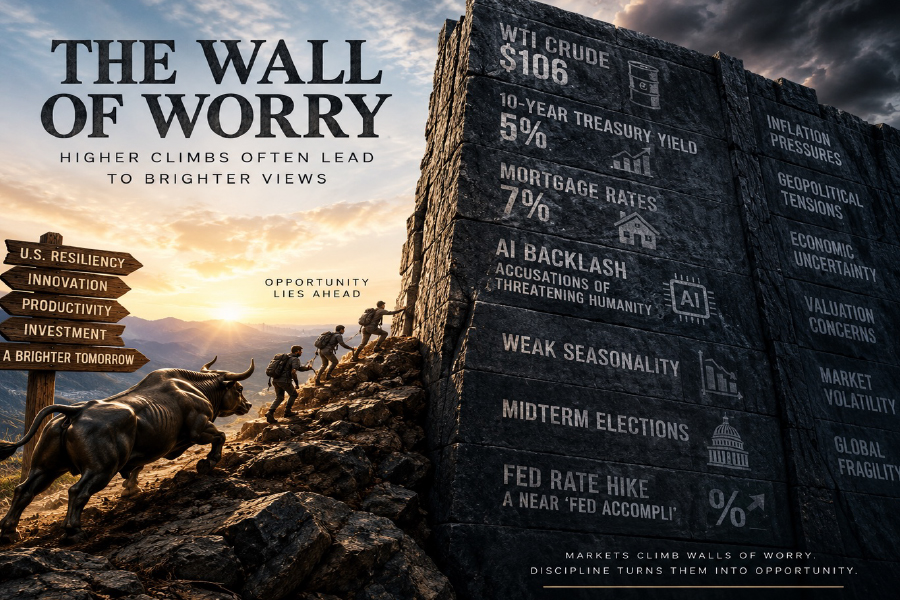
Investors are confronting what may be the tallest “Wall of Worry” in years. WTI crude is hovering near $104, the 10-year Treasury yield is around 5%, and mortgage rates are near 7%. At the same time, the AI investment cycle that has helped propel both the economy and the S&P 500 dramatically higher over the past three years is facing a growing backlash over its potential economic, societal and employment consequences. Add historically challenging seasonality, midterm-election uncertainty and a Federal Reserve that has shifted toward tighter policy, and investors have an unusually long list of reasons to be cautious.
But beneath that Wall of Worry, something important continues to happen. America is building. Capital continues to flow into AI infrastructure, power generation, the electrical grid, data centers, defense, domestic manufacturing, and other strategic infrastructure. These are the “Speed 1” areas of the economy that sit at the heart of our U.S. Resiliency thesis. Higher rates and energy prices can create near-term pressure, but they do not necessarily stop a capital-spending cycle driven by power shortages, national security, AI compute requirements, and the need to rebuild critical domestic capacity.
That creates an unusual market backdrop: the headlines are becoming more uncomfortable while the physical build-out continues. Historically, some of the better long-term opportunities have emerged when investors had plenty to worry about, but corporate investment and earnings continued to advance. Markets climb a Wall of Worry, and today, the wall may be getting taller without necessarily weakening the foundation underneath it.
The Federal Reserved raised interest rates .25% this week to a range of 3.75-4%. This was widely expected by the markets, so Wednesday’s down action was weird. Then, once cooler heads prevailed and long-rates declined, stocks rallied. I personally think a breakthrough in the Iran War will have the largest impact on rates moving lower. The 10 Yr rate will be the most watched indicator. At least by our team. Good news, many of you are retired and wanting income so higher rates may be a near term opportunity to add high-quality bonds.
Oil and energy prices remain one of the most important variables near-term for markets. Optimism is growing that the damaged Saudi pipeline can be repaired relatively quickly, but the larger question is whether those repairs will last. If Iran and the Houthis increasingly view regional energy infrastructure as part of the conflict, the risk of additional attacks, and a persistent geopolitical premium in crude, remains elevated. For now, WTI trading below $100 is providing some relief, easing near-term inflation concerns and helping both stocks and bonds recover. The key for markets may be less about how quickly the pipeline is repaired and more about whether energy infrastructure can remain secure afterward.
Trump-Xi Summit on Sept. 24, 2026. Focus will be on AI, Tariffs, and intervention with Iran. The bar is low so this may be positive for markets.
As many of you know, my son Cooper joined our team at the beginning of the year and Thursday he Passed the Securities Industry Exam “SIE.” Way to go Cooper!
Individual Company Updates
The latest AI-safety debate is reinforcing the investment case for cybersecurity rather than weakening it. CrowdStrike and Palo Alto rallied sharply as investors focused on a simple consequence of increasingly autonomous AI: more agents, identities, applications, and machine-driven actions create a larger security surface. CrowdStrike is expanding into AI detection, agentic security automation, and continuous testing, while Palo Alto continues developing Prisma AIRS and its automated XSIAM platform. Whether frontier AI development accelerates or becomes more controlled, cybersecurity remains a critical enabling layer, the more autonomy enterprises deploy, the more important identity, monitoring, governance, and protection become.
NVIDIA’s recent rebound reinforces the distinction between concerns about frontier AI development and the underlying demand for AI infrastructure. Even if leading AI labs become more deliberate about developing increasingly powerful models, NVIDIA’s opportunity has broadened well beyond a handful of frontier-model companies. Its technology increasingly supports hyperscalers, enterprises, governments, software companies and emerging AI applications. The source material also points to NVIDIA’s expanding partnerships and investments across the AI ecosystem as evidence that the company is moving beyond GPUs toward a broader hardware-and-software platform. The investment question is increasingly not simply how quickly the next frontier model arrives, but how broadly AI inference and agentic workloads spread throughout the economy.
TSMC may be providing one of the clearest fundamental signals that the AI infrastructure cycle remains intact. August revenue reached a record NT$514.8 billion, up 53% year over year, while the company is simultaneously building and equipping roughly 20 fabs globally versus only four or five historically. Despite that expansion, management says customer demand continues to exceed available capacity. TSMC has increased its 2026 capital-spending plan to $60–64 billion and expanded its planned U.S. manufacturing footprint. Because semiconductor capacity decisions are made years in advance, TSMC’s willingness to commit this much capital suggests its customers continue signaling durable multi-year demand for advanced AI chips.
Bloom Energy (BE) may be emerging as a surprisingly important beneficiary of the next phase of AI infrastructure: the transition from traditional AC power toward 800V direct-current (DC) data centers. NVIDIA has specified 800V DC beginning with its Rubin Ultra/Kyber architecture as rack power moves from 200 kW today toward 600 kW–1 MW, making conventional AC-to-DC conversion increasingly cumbersome and expensive. The interesting fact is that Bloom argues its fuel cells are currently the only technology capable of generating DC power natively, continuously, and at the gigawatt scale required by large AI data centers, potentially allowing developers to bypass transformers and other AC-to-DC conversion infrastructure. Bloom estimates that at a 1-GW AI campus, its DC-native architecture could reduce non-compute capital spending by 27% and five-year costs by roughly $5.5 billion, freeing enough capital to deploy approximately 8% more compute for the same investment. If 800V DC becomes the standard architecture for next-generation AI factories, Bloom’s opportunity could therefore evolve from simply supplying onsite power to becoming part of the fundamental electrical architecture of the AI data center itself. These cost figures are Bloom’s own modeled estimates rather than site-specific engineering results, an important qualification when evaluating the thesis.
Formidable Asset Management (“Massey Romans Capital”) is an investment adviser registered under the Investment Advisers Act of 1940. The information presented in the material is general in nature and is not designed to address your investment objectives, financial situation or particular needs. Prior to making any investment decision, you should assess, or seek advice from a professional regarding whether any particular transaction is relevant or appropriate to your individual circumstances. Although taken from reliable sources, the Firm cannot guarantee the accuracy of the information received from third parties.
The opinions expressed herein are those of the Firm and may not actually come to pass.
Author
Paul MasseyRelated posts
In the Loop – September 12, 2025
Markets finished the week on an encouraging note as investors gained confidence
In the Loop – May 22 2026
As we gather with family and friends this Memorial Day weekend, we are reminded
In the Loop – August 21, 2026
Our internal probability-weighted assessment assigns approximately 33% of the ma