



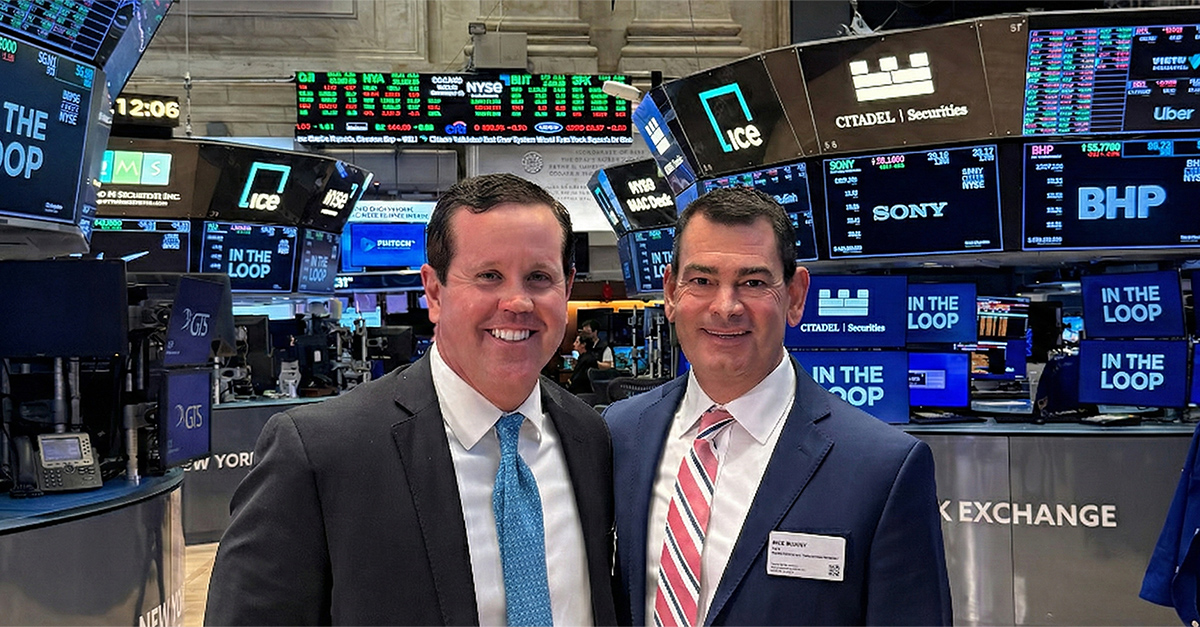
In the Loop – September 4, 2026
“In The Loop” is designed to give you a short update reflecting major developments, earnings, and investment trends across some core Equity Income and Growth holdings. All clients should be aware that individual buy/sell recommendations will be conveyed directly to you on an individual basis. Have a great weekend.
We experienced some technical difficulties last week and were unable to send out our “In The Loop” update. With the previous update so long, you probably needed a break anyway! This weekend marks the unofficial end of summer with a day off on Monday for Labor Day. The transition from summer to fall typically means summer vacations wind down, kids are back in school, college football begins (Go Gators!) and businesses shift toward their fall season. And for those of us in Florida, we welcome the “slightly” cooler weather.
Our monologue two weeks ago about the Federal Reserve and the Jackson Hole meeting ended without a bang. In our opinion, it was an opportunity lost. Yes, he needed to talk tough about inflation, but we were hopeful that he would use the opportunity to share some new findings from the newly created task forces and how these changes would affect the reaction function going forward. One possible view into Warsh’s thinking came from how he highlighted the PCE diffusion Index (DI) as a gauge of underlying inflation. Notably, that it is much lower today at 54 versus the pandemic peak at 77. We still believe our thesis from two weeks ago will play out. New Fed with New communication tactics. We also stand by our thoughts that the two biggest drivers of market performance over the next 12 months will likely be based on Earnings and the New Fed’s Monetary Policy.
If we roll the tape back to February 27, 2026, when the Iran War began, Oil was $67 a barrel and the interest rate on the 10-Year Treasury Bond was 3.83%. Six Months later, Oil is $90, the 10 Year rate 4.8% AND the S&P 500 is 12% HIGHER! Why? Earnings have been fantastic! Imagine closure to the Iran War, Oil prices retreat, inflation cools, interest rates drop. What a tailwind that could be.
Bloomberg data shows roughly 32% year-over-year EPS growth in Q2 2026, following a 30% jump in Q1, fueled by broad-based profit strength and clearer AI monetization across mega-cap tech. The strength has prompted an unusual mid-cycle wave of upward estimate revisions with consensus 2026 and 2027 EPS forecasts now sit about 4% above January levels. The bottom-up analyst consensus has surged from roughly $358 at the start of 2026 to around $409 most recently, putting the central 2027 S&P 500 EPS forecast near $400–$410, with bank estimates spanning from Goldman’s $385 to JPMorgan and Deutsche Bank’s $420. Back of the napkin math: P/E multiple of 20 x $410= SP500 at 8200. Therefore, the trend is still higher.
Looking forward we see massive opportunities and advancements in Healthcare, the AI ecosystem, Power and Infrastructure, Financials and Exchanges because of a steeping yield curve and I’ll end with “Nothing Runs like a Deere”- John Deere (DE) at an All-time high.
Individual Company Updates
NVIDIA delivered another exceptional quarter, with revenue rising 106% year over year to $96.2 billion and data-center revenue increasing 117% to $89.0 billion. Gross margin remained at an impressive 75%, while management guided to approximately $108 billion of revenue for the next quarter. More importantly, the business is expanding beyond GPUs into complete AI factories, including Vera Rubin systems, Spectrum-6 networking, agent-focused CPUs, advanced memory partnerships and power-ready deployment sites. Rubin’s move into full production reinforces the view that AI spending is broadening from individual model developers to a much larger ecosystem of hyperscalers, sovereign AI projects and physical-AI applications. NVIDIA remains one of the clearest beneficiaries of the AI infrastructure and agentic-computing cycle, although expectations are extremely high and the company’s next phase will require continued execution, stable margins and sustained customer capital spending.
CrowdStrike produced a powerful second-quarter report, with revenue increasing 26% to $1.47 billion, annual recurring revenue rising 25% to $5.84 billion and record net-new ARR of approximately $333 million. The company also generated $377 million of free cash flow and expanded non-GAAP subscription gross margin to 81%, demonstrating that growth is increasingly converting into durable cash generation. Falcon Flex adoption continues to accelerate, while new offerings focused on AI-agent identity, cloud security, SIEM and threat detection are broadening CrowdStrike’s role across the enterprise security stack. Management raised its fiscal 2027 outlook, calling for nearly $6.0 billion of revenue and more than $6.6 billion of ARR.
Eli Lilly continues to expand its obesity and diagnostic franchises while attracting increased institutional interest, including a substantial second-quarter purchase by Citadel. Its oral GLP-1 treatment, Foundayo, has now entered the United Kingdom, creating a new European commercial opportunity at a price below the company’s injectable obesity therapies. The drug generated approximately $98 million in second-quarter sales following its U.S. launch, providing an early indication of demand. Lilly also received FDA clearance for Elecsys pTau217, an Alzheimer’s blood test developed with Roche that can operate on existing laboratory systems and be distributed through Labcorp and Quest. The combination of an expanding oral obesity platform and broader diagnostic access strengthens Lilly’s long-term growth prospects, although manufacturing capacity, reimbursement and competition across the GLP-1 market remain important variables.
Amazon could possess significant strategic and financial upside through its investment in Anthropic. It could be the largest investment gain in its corporate history if the Claude developer eventually reaches a reported $2 trillion public-market valuation, Amazon’s estimated 20% ownership could be worth approximately $400 billion compared with roughly $13 billion invested to date. The opportunity extends beyond the value of the equity stake: Anthropic has committed to spending more than $100 billion on AWS computing and related services over the next decade, allowing Amazon to benefit from both the success of the AI company and the infrastructure required to operate it.
nVent is broadening its data-center opportunity through the $1.75 billion acquisition of Maverick Power, a manufacturer of switchgear, control panels and power-distribution systems. Maverick is expected to contribute approximately $700 million of 2026 revenue and adds products that complement nVent’s existing liquid-cooling capabilities. The combination should give nVent a more complete offering as AI facilities requires increasingly sophisticated power delivery, thermal management and electrical controls. Management expects the transaction to be accretive to adjusted earnings in its first year, with the purchase price equating to roughly 11.5 times projected 2026 adjusted EBITDA before tax benefits. Maverick’s backlog provides near-term visibility, but we will be monitoring integration, the potential additional $550 million performance payment and whether data-center demand remains strong enough to justify the acquisition premium.
AI power delivery is becoming a major new growth engine. Next-generation GPUs and custom accelerators require enormous current at extremely low voltage. ADI can now address the entire path from the electrical grid to the processor. Its Empower acquisition adds vertical power-delivery technology that could reduce AI-compute energy use and heat by approximately 10%–15%—potentially saving around $30 million annually in a 1-GW data center. The financial model is unusually powerful. ADI generated $4.9 billion of trailing free cash flow, and Q4 guidance implies approximately 74% adjusted gross margin and 52% adjusted operating margin. That means incremental AI and industrial revenue produces exceptional earnings leverage.
Arm continues to strengthen its position as a key beneficiary of the AI infrastructure buildout. Revenue rose 22% year over year to a record $1.29 billion, while data-center royalties more than doubled as Arm-based processors gained traction across cloud and AI workloads. The company is also expanding beyond traditional licensing with its Arm AGI CPU, where management says customer demand now exceeds $2 billion across fiscal 2027 and 2028. Arm architecture is increasingly embedded across the AI ecosystem, including NVIDIA’s Vera CPU, Google’s Axion processors, AWS Graviton and Microsoft Cobalt. We believe the larger story is ARM’s evolution from a mobile-focused licensing company into a critical computing platform spanning data centers, PCs, robotics, automobiles and edge AI. Valuation remains a risk, but accelerating AI adoption could significantly expand both ARM’s addressable market and the value it captures from each generation of computing.
Union Pacific continues to deliver strong operating results while the proposed Norfolk Southern merger becomes the key catalyst for the stock. Second-quarter revenue increased 12% to $6.9 billion, net income rose 6% to $2.0 billion, and adjusted EPS increased 13% to $3.41, supported by volume growth, pricing and improving network efficiency. Management also raised its 2026 EPS growth outlook to the high-single digits. The bigger story is the proposed combination with Norfolk Southern, which would create the first single-line transcontinental U.S. railroad spanning more than 50,000 miles. Importantly, the Surface Transportation Board recently removed the regulatory proceeding from abeyance and began the formal merits review—an incremental step forward, although approval remains uncertain. We continue to view UNP as a strong fit within our U.S. Resiliency theme, benefiting from domestic manufacturing, infrastructure investment and the need for efficient movement of goods across the country. If the Norfolk Southern transaction is ultimately approved, we believe the combination could materially strengthen UNP’s long-term competitive position and create an increasingly valuable national logistics network.
Formidable Asset Management (“Massey Romans Capital”) is an investment adviser registered under the Investment Advisers Act of 1940. The information presented in the material is general in nature and is not designed to address your investment objectives, financial situation or particular needs. Prior to making any investment decision, you should assess, or seek advice from a professional regarding whether any particular transaction is relevant or appropriate to your individual circumstances. Although taken from reliable sources, the Firm cannot guarantee the accuracy of the information received from third parties.
The opinions expressed herein are those of the Firm and may not actually come to pass.
Author
Paul MasseyRelated posts
In the Loop – November 14, 2025
Spending Veteran’s Day at the New York Stock Exchange supporting our friends a
In the Loop – February 27, 2026
The calm at the index level hides strong currents beneath the surface. The S&P 5
In the Loop – July 24, 2026
98 S&P 500 companies have reported 2Q results. Reported Sales growth has been +1